Arms in a Golf Swing Secrets That Will Transform Your Game
Your arms are the engine of every golf swing. Understanding how to use your arms correctly in a golf swing can add distance, improve accuracy, and eliminate frustrating slices and hooks. This guide breaks down the arms in a golf swing mechanics that matter most, from setup to impact and follow-through.
Key Takeaways
- Arm position at setup sets the foundation for a consistent swing plane and proper club delivery.
- Arm rotation through the downswing generates power and helps you square the clubface at impact.
- Tension in the arms is the number one swing killer that most amateur golfers don’t even realize they have.
- Arm hinge and release at the right moment creates clubhead speed and adds serious distance to your shots.
- Practicing specific arm drills will build muscle memory and help you feel the correct positions on the course.
- Arm sequencing in the downswing ensures your body and arms work together instead of fighting each other.
📑 Table of Contents
- Why Your Arms Are the Key to a Better Golf Swing
- The Role of Arm Rotation in Generating Power
- Common Arm Mistakes That Hurt Your Game
- How to Properly Position Your Arms at Address
- Drills to Improve Arm Action in Your Swing
- Arms and the Downswing Sequence
- Putting It All Together: Arms in a Golf Swing on the Course
- Conclusion
Why Your Arms Are the Key to a Better Golf Swing
Let’s talk about something that changes everything once you understand it. Your arms in a golf swing do more work than almost any other part of your body. They connect your core rotation to the clubhead. They control the swing plane. They determine whether the ball flies straight or wildly off target.
Most golfers think about their hips or their shoulders when they try to improve. And those body parts matter, absolutely. But your arms are the direct link between your body and the golf club. If your arms aren’t working correctly, nothing else in the swing can compensate fully.
The good news? You don’t need to be a professional athlete to fix your arm action. A few simple changes and some focused practice can make a huge difference. Whether you’re a beginner just learning the basics or a seasoned player looking to fine-tune your technique, understanding your arms in the golf swing is a game-changer.
When you think about all the pieces that go into a golf swing, the arms in a golf swing deserve serious attention. They start the movement, they guide the club, and they finish the job. Let’s break down exactly how that works and what you can do about it.
The Role of Arm Rotation in Generating Power
Power in the golf swing doesn’t come from your arms alone. But your arms are the delivery system for that power. When your arms rotate correctly through the ball, they create a whipping action that transfers energy from your body into the clubhead.
How Arm Rotation Works
During the backswing, your lead arm rotates upward as your shoulders turn. Your trail arm folds naturally at the elbow. This creates what coaches call the “triangle” between your arms and shoulders. That triangle stays intact through the first half of the downswing.
Then comes the release. Your arms unhinge and rotate through the impact zone. This is where the magic happens. The rotation of your arms, combined with the lag you created earlier, generates tremendous clubhead speed.
Here’s a simple way to think about it. Imagine your arms are windshield wipers. They rotate around a fixed point at your shoulders. The faster and smoother they rotate, the more speed they generate at the end of the arc. That’s basically what happens in your golf swing.
Common Rotation Mistakes
- Over-rotating the lead arm on the backswing, which closes the clubface too early.
- Spinning the arms too fast through impact, causing a loss of control.
- Failing to rotate the arms fully through the follow-through, leaving power on the table.
- Using only the trail arm to generate speed, which creates an inconsistent swing path.
Fixing these rotation issues alone can add 10 to 20 yards to your drives. That’s a massive improvement from a simple mechanical adjustment.
Common Arm Mistakes That Hurt Your Game
Every golfer makes arm mistakes. The difference is that better golfers recognize them and fix them quickly. Here are the most common arm mistakes in golf swing that are holding you back right now.
Too Much Tension
This is the silent swing killer. When you grip the club too tightly, your arms tense up. Tight arms restrict your range of motion. They slow down the club. They make it nearly impossible to release the club properly through impact.
Think about it this way. Can you swing a golf club with the same speed if your arms are stiff as boards versus relaxed and loose? Of course not. The difference can be 15 to 25 miles per hour of clubhead speed. That’s the difference between a 200-yard drive and a 175-yard one.
The fix is simpler than you think. Take a deep breath before you start your swing. Consciously relax your arms from your shoulders down to your fingertips. Your grip pressure should be about a 4 out of 10. Firm enough to hold the club, loose enough to let the arms move freely.
Chicken Wings
The “chicken wing” happens when your lead arm bends too much through impact. Instead of extending toward the target, your elbow sticks out to the side. This creates a steep, inconsistent swing path and usually produces a slice or a weak push.
When your arms fold up like that, you lose all the leverage and extension that create power. The clubhead slows down dramatically, and you end up leaving the ball short of your target more often than not.
Arms Too Far from the Body
Another common error is keeping your arms too disconnected from your torso during the swing. When your arms fly away from your body on the backswing, you lose the connection to your core rotation. This creates a “two-piece” swing where your arms and body are working independently instead of together.
The result is a loss of power and consistency. Your swing becomes harder to repeat because there’s no stable base for the arms to work from.
How to Properly Position Your Arms at Address
The setup is where every good swing begins. If your arm position at address is wrong, the rest of the swing has to compensate. And compensation leads to inconsistency.
The Right Arm Hang
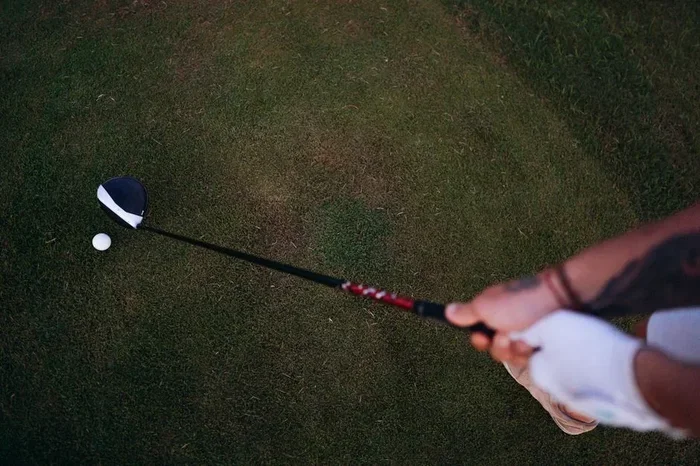
Stand tall with your feet shoulder-width apart. Let your arms hang naturally from your shoulders. They should dangle straight down with a slight bend at the elbows. Your hands should be directly under your shoulders, not out in front of you or behind you.
This natural hang position is where your arms feel most relaxed and balanced. It’s the starting point for a clean, efficient swing path.
Grip and Arm Connection
Your grip connects your arms to the club. When you set up correctly, your arms should feel like they’re resting on top of the club, not fighting it. The 10 Finger Grip In Golf is one popular method that helps create a solid connection between your arms and hands. A proper grip ensures your arms can work freely without fighting the club.
Take a look at your setup in a mirror. Your arms should form a gentle triangle with your shoulders. The club should rest across the base of your fingers, not deep in your palms. This setup position allows your arms to hinge naturally during the swing and release freely through impact.
The Triangle Concept
That triangle formed by your arms and shoulders is one of the most important concepts in golf. When you maintain this triangle through the first part of the backswing and downswing, your arms stay connected to your body rotation. The club stays on plane. And the swing becomes much more repeatable.
Many golfers lose this triangle too early in the downswing. Their arms get ahead of their body, and the whole sequence falls apart. Keeping the triangle intact as long as possible is one of the simplest ways to improve your arm action immediately.
Drills to Improve Arm Action in Your Swing
Knowing what good arm action looks like is one thing. Actually doing it on the range is another. These drills will help you build the right arm mechanics for golf swing and make them stick.
Drill 1: The Arm Swing Without a Club
Stand in your address position without a club. Swing your arms back and through, focusing on the rotation of your shoulders and the natural hinge of your elbows. This drill isolates your arm movement and helps you feel the correct positions without the distraction of a club.
Do 20 to 30 swings like this before every practice session. You’ll be surprised how quickly your body learns the correct rhythm and tempo. This simple drill builds the muscle memory you need for better on-course performance.
Drill 2: The One-Arm Swing
Grab a light iron and swing with just your lead arm. Focus on keeping the arm straight but not locked. Feel how your shoulder rotates and pulls the arm through the swing. Then switch to your trail arm and repeat.
This drill teaches each arm to work independently while staying connected to your body rotation. It’s especially helpful for fixing the chicken wing problem because it forces you to extend your arm toward the target on the through-swing.
Drill 3: The Towel Drill
Fold a towel in half and tuck it under your lead arm. Make swings while keeping the towel tucked against your body. If the towel falls out, your arm has separated from your torso.
This is one of the most effective drills for maintaining arm-body connection. It gives you instant feedback on whether your arms are staying connected to your rotation throughout the swing. Do this drill for 10 to 15 minutes per practice session, and you’ll see real improvements in your swing consistency.
Arms and the Downswing Sequence
The downswing is where everything comes together. Your body starts the downswing from the ground up, and your arms follow. The sequence matters enormously for both power and accuracy.
The Correct Sequence
Your lower body starts the downswing by shifting toward the target and rotating your hips. Your torso follows. Then your arms drop into the slot. Finally, your hands and the club release through impact.
When this sequence works correctly, your arms arrive at the ball in the perfect position. They have maximum speed and maximum control. The clubface is square to the target line, and the ball flies straight and true.
What Happens When Arms Get Out of Sequence
When your arms start the downswing too early, you get what’s called “casting” or “over-the-top.” The club gets stuck on an outside-in path, and the result is usually a slice or a push. Your arms are working against your body instead of with it.
The fix is to let your lower body lead. Trust that your arms will fall into the right position if you start the downswing with your hips and legs. This feels slow at first, but the clubhead speed will actually increase because you’re creating more lag and a more efficient energy transfer.
Arm Extension Through Impact
One of the best indicators of a good swing is arm extension through the impact zone. When your arms fully extend toward the target after striking the ball, you know you’ve delivered the club correctly. The extension creates a low point that’s just after the ball, which produces clean contact and optimal trajectory.
Think about a pitcher throwing a baseball. The arm extends fully toward the target after releasing the ball. Your golf swing works the same way. The extension is the proof that everything in the kinetic chain is working together correctly.
Putting It All Together: Arms in a Golf Swing on the Course
Understanding the mechanics is step one. Applying them on the course is where the real transformation happens. On the range, you can think about every detail of your arm position and rotation. On the course, you need to trust your body and let the arms do their job.
The best approach is to practice the drills regularly until the correct positions feel natural. Then, when you step onto the first tee, you can trust that your arms in a golf swing will work the way they should. Overthinking on the course leads to tension, and tension leads to bad shots.
Also, remember that your equipment matters. When your clubs fit properly, your arms can work more efficiently. Getting a proper fitting ensures that the club length, grip size, and shaft flex all support your natural arm movement. A well-fitted setup removes barriers and lets your arms swing freely.
Finally, be patient with yourself. Changing your arm action takes time. You might feel awkward for the first few weeks of practice. That’s completely normal. Stick with the drills, trust the process, and the results will come. Your arms in a golf swing are the bridge between your body’s rotation and the clubhead’s path. Master that bridge, and you’ll see a noticeable difference in every aspect of your game.
Whether you’re working on your driver off the tee or your short game around the greens, your arms play a role in every shot. Give them the attention they deserve, and you’ll be on your way to lower scores and more enjoyment on the course.
Conclusion
The arms in a golf swing are more important than most golfers realize. They generate power, control the club path, and determine the quality of contact with the ball. By understanding proper arm rotation, fixing common mistakes, and practicing targeted drills, you can transform your swing and your scores.
Start with the setup position. Make sure your arms hang naturally and form that key triangle with your shoulders. Focus on keeping your arms relaxed and connected to your body rotation throughout the swing. Practice the drills consistently, and trust the process on the course.
Your arms are the link between your body and the club. Treat them with the attention they deserve, and they’ll reward you with longer, straighter, and more consistent shots. The secrets of the arms in a golf swing aren’t really secrets at all. They’re just fundamentals that most golfers overlook. Now that you know them, you have the advantage.
Frequently Asked Questions
What is the most common arm mistake in a golf swing?
The most common mistake is too much tension in the arms and hands. When golfers grip the club too tightly, their arms become stiff and restricted. This tension kills swing speed and makes it nearly impossible to release the club properly through impact. Focus on keeping a light, relaxed grip to let your arms swing freely.
How do I stop my arms from getting out of sequence in the downswing?
The key is to let your lower body start the downswing. Your hips and legs should initiate the movement, and your arms should follow naturally. If your arms start too early, you’ll lose the lag and power. Practice starting your downswing by shifting your weight toward the target and rotating your hips first. Your arms will fall into place on their own.
Can arm position affect my golf swing plane?
Absolutely. Your arm position at setup determines where the club starts on the backswing. If your arms are too far from your body or too tight against it, the swing plane gets distorted. A neutral arm hang with the club resting naturally creates the best foundation for a consistent swing plane and proper delivery to the ball.
How can I tell if my arms are connected to my body during the swing?
The towel drill is the best test. Tuck a towel under your lead arm and make swings. If the towel stays tucked throughout the swing, your arms are connected to your body rotation. If it falls out, your arms are separating too early, which leads to a loss of power and consistency.
Should my arms be fully extended at impact?
Your arms should be extending toward the target through the impact zone, but not completely locked out. There should be a natural, slight bend in the elbows as you strike the ball. Full extension comes just after impact, as your arms reach toward the target on the follow-through. This extension is a sign of a well-delivered swing.
How long does it take to fix arm problems in a golf swing?
It depends on how ingrained the habits are, but most golfers see noticeable improvement within 4 to 6 weeks of consistent practice. Focus on one or two drills at a time rather than trying to fix everything at once. The key is repetition. Your muscles need time to learn the new positions and turn them into habits that stick on the course.